
Choosing Banding Material

How to Choose a Bundling Machine
2026-09-14
Promotional Packaging for Co-Packers
2026-09-21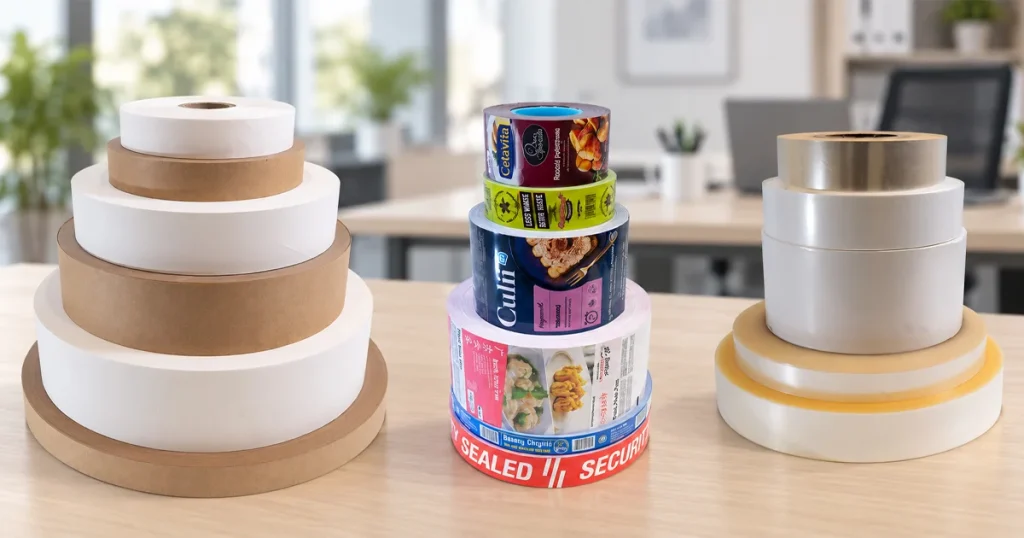
Choosing banding material comes down to four decisions, and only one of them is the paper-or-film question everyone opens with. Thickness, print, and how the band goes around the product all move the cost per pack more than most buyers expect.
What people actually want to know is what a band will cost them. That number is calculable, and the arithmetic is at the end of this article.
Paper or film
Paper suits dry, chilled and ambient packs. It prints edge to edge, matt or gloss, and it goes into ordinary paper recycling rather than a specialist plastic stream. For a brand with a plastic reduction target, it is usually the easiest visible change available: same machine, same speed, different roll.
Film goes where moisture does. Frost on a pack leaving a blast freezer, condensation on a chilled tray, a damp warehouse in August. Paper weakens against all three.
In this region most customers end up on film. That is not a recommendation so much as an observation about the climate and about what gets banded here: a lot of chilled and frozen product, a lot of condensation, a lot of packs that sit in conditions paper would not survive.
Thickness: the lever nobody mentions
Film runs from 35 to 100 micron. The usual specification is 50.
Here is the part that does not appear in any brochure: going thinner costs you nothing on most products. Dropping from 60 micron to 50 takes real money off the consumable bill and the band holds exactly as well, unless the product is genuinely heavy.
Weight is the only real constraint. A stack of chilled trays, a multipack of pouches, a bundle of cartons — all of these run happily on thinner film. A heavy bundle that will be handled, stacked and moved is where thickness starts earning its cost.
So the question to ask a supplier is not “what thickness do you recommend” but “what is the thinnest that works for this product”. Most of the time the answer is thinner than what you are currently buying.
So the question to ask when choosing banding material is not “what thickness do you recommend” but “what is the thinnest that works for this product”.
Printed or plain
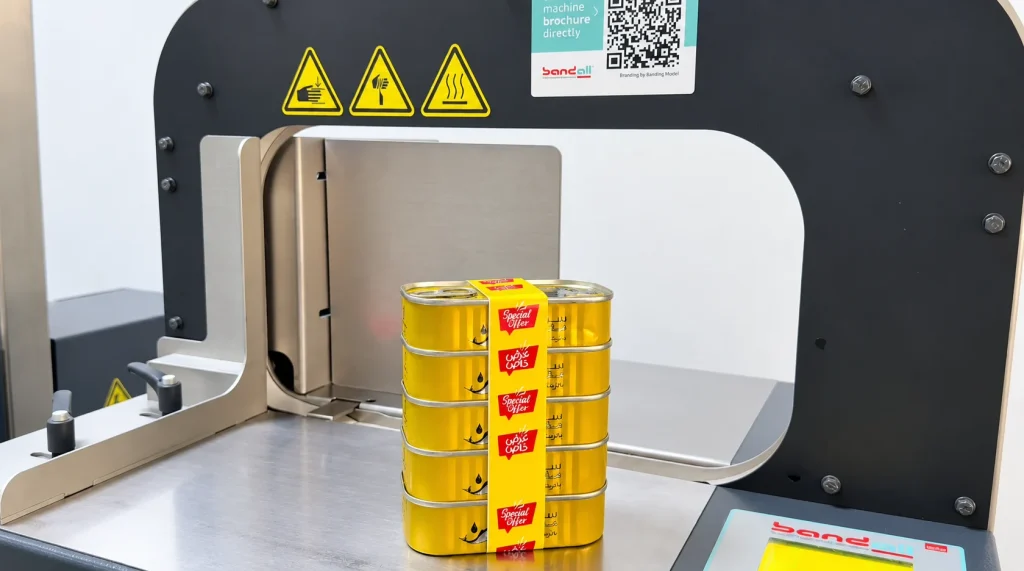
A plain roll is the flexible one. New product, new pack size, new line — nothing changes. The machine carries on, the operator carries on. If you print variable data inline, a plain roll takes batch numbers, weights, dates and barcodes at the moment of banding, from a file rather than from a stock of labels.
A printed roll carries fixed artwork: your branding, a promotional message, a permanent barcode. It looks better on shelf and it needs no printer on the machine.
Two things to plan for if you go printed. The minimum order is 100 rolls, and the lead time is about three weeks.
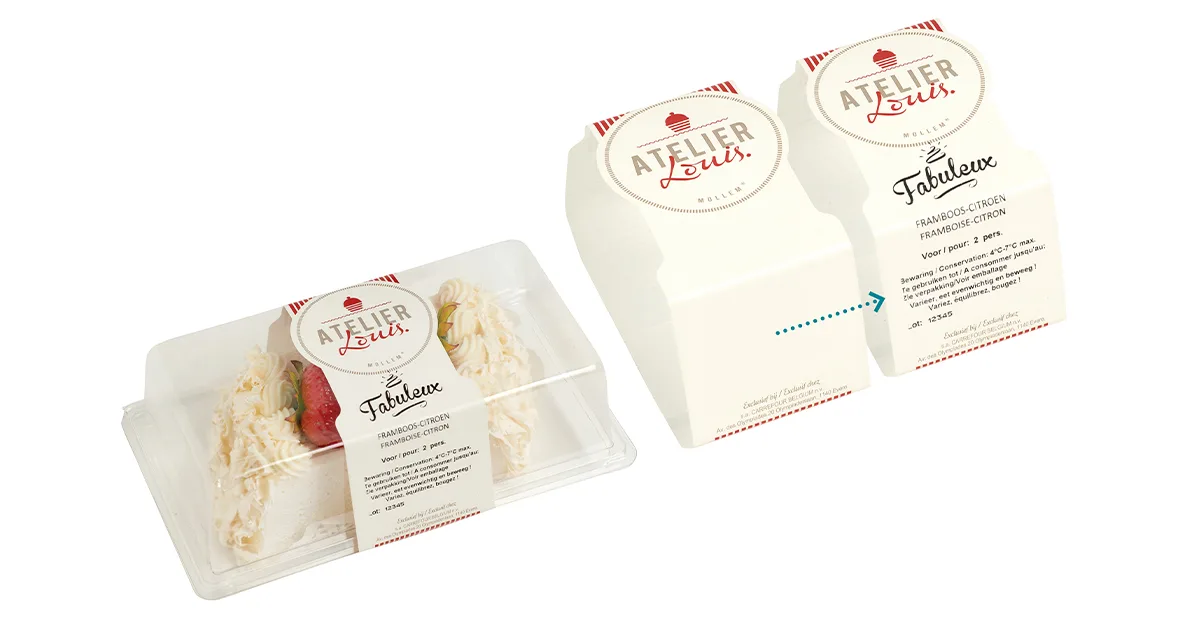
That is worth being straight about, because banding is often sold as though it has no ordering constraints at all. It does. What it does not have is tooling. A cardboard sleeve needs a die cut for every pack size, plus a minimum order, plus a lead time, plus usually a lamination on top. A printed band needs a cylinder per colour — a print setup, not a piece of steel — and then the same roll runs at any length you want.
Most operations end up running both: plain rolls with inline printing for everything that changes, printed rolls for the lines where the artwork is fixed and the volume justifies it.
How the band goes on changes what it costs
This is the decision most cost estimates miss entirely, and it can double your material cost per pack.
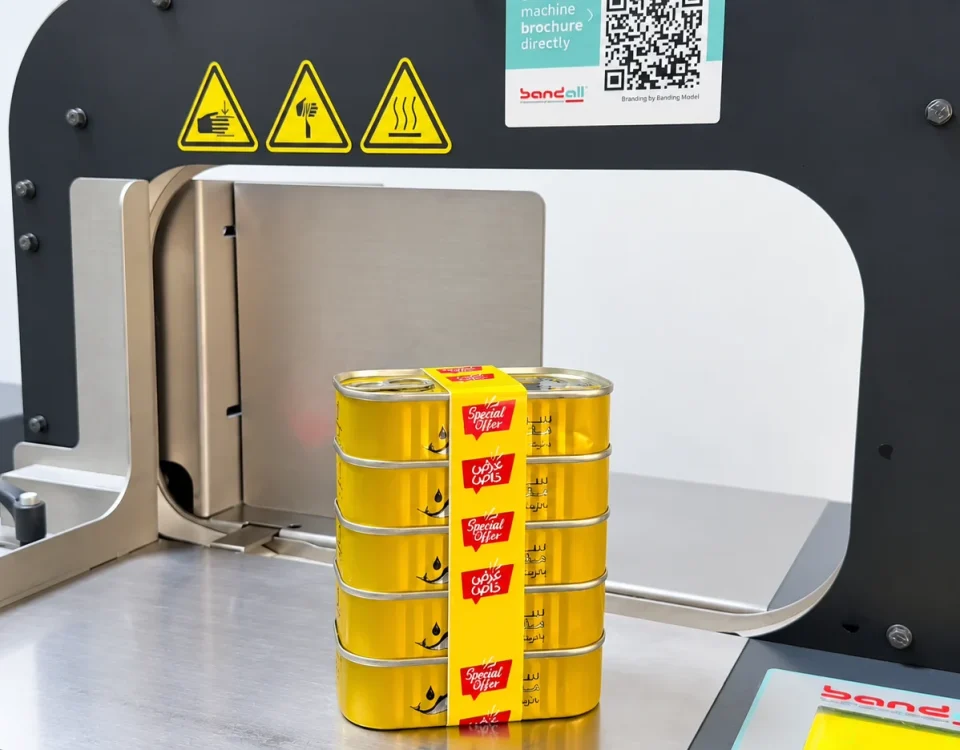
The band length you need is the circumference of the product plus two centimetres for the overlap. Band the short side of a rectangular pack and that might be 41 cm. Band the long side and the same pack needs 60. Same product, same machine, fifty percent more material.
Some products need more than one band. Four lengths of timber at 60 cm tall are better held with two parallel bands than one — the bundle is stable rather than pivoting on a single point. That doubles the consumption, and it is the right call anyway.
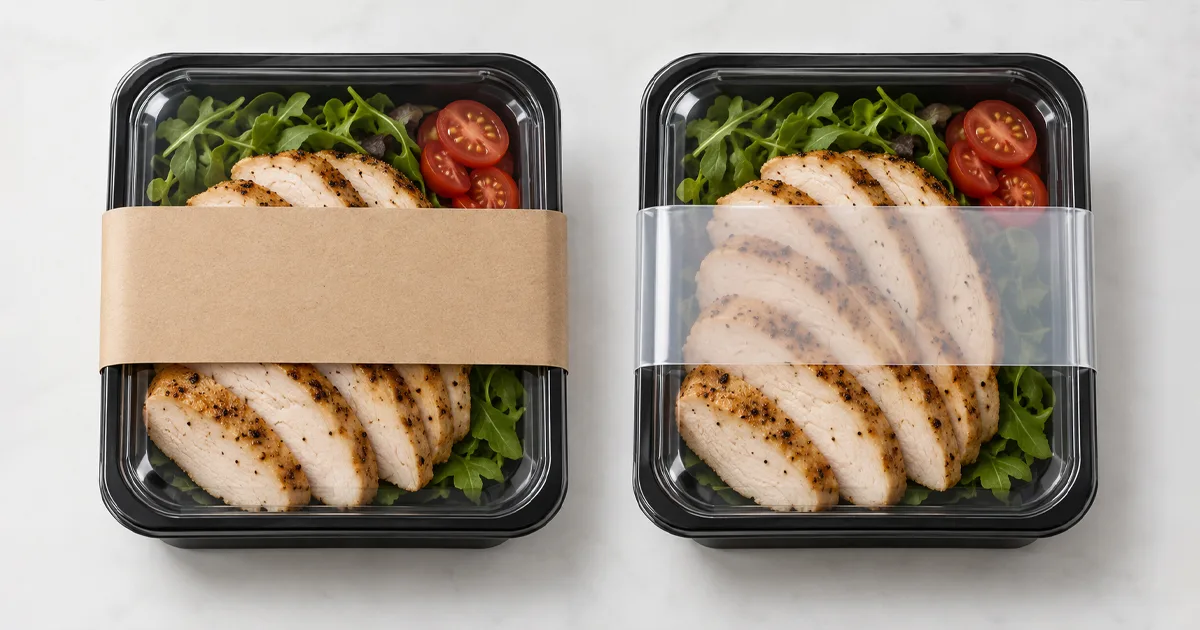
Others need cross banding: two bands at right angles. Frozen packs, packaging pouches, three-packs and four-packs of chilled chicken. Anything where a single band would let the contents slide out sideways.
None of this is a problem. It just means the cost per pack cannot be quoted until somebody has decided how the product gets banded — which is one of the things a demo settles.
Working out what it actually costs
Three steps, and you can do them yourself.
Measure the circumference of the product where the band will sit. Add two centimetres for the overlap. That is your band length per pack.
Divide the roll length by that figure. That is how many packs one roll gives you.
Divide the roll price by the number of packs. That is your material cost per pack.
A worked example. Two 400 g cheese packs banded together for a promotion measure 39 cm around, plus 2 cm overlap, so 41 cm of band each. A 2,000 metre roll divided by 0.41 metres gives roughly 4,878 packs. Roll price divided by 4,878 is what the band costs you per promotional pack.
Run the same arithmetic at 50 micron instead of 60 and the roll is cheaper while the pack count stays identical. That is where the thickness conversation pays for itself.
Where another material is the right answer
A band is not the material for every holding job, and it is worth knowing the edges.
Heavy or long loads belong to steel or PET strapping under high tension. Structural timber, steel bar, pallet loads. No banding material at any thickness is built for that.
Sealing a shipping carton belongs to adhesive tape. A band crosses a box; it does not close one.
A full moisture barrier across the whole pack belongs to shrink film. A band covers a fraction of the surface by design — which is exactly why it uses up to 80% less material than shrink, and exactly why it cannot do the same job.
Getting samples
The fastest way to settle material is to hold it. Send us your product, or bring it to the showroom in Dubai Investments Park, and we will band it on the material that suits it and send back the banded samples along with photographs and video, within two working days.
Tell us your current production figures at the same time and we will run the cost calculation above for your actual pack rather than a worked example.
The fastest way to settle on banding material is to hold it.
Request samples — get in touch, browse the full banding material range, or compare film and paper side by side. If banding is new to you, start with what banding is.
Frequently asked questions
What is banding material made of?
Either paper or film. Paper suits dry, chilled and ambient packs and recycles through the ordinary paper stream. Film suits anything meeting moisture: frozen packs, condensation, damp storage.
How thick is banding film?
It runs from 35 to 100 micron, and 50 is the usual specification. Thinner film is cheaper and holds just as well on most products; weight is the only real constraint.
How many packs does one roll of banding material give?
Measure the circumference of the product, add two centimetres for the overlap, and divide the roll length by that figure. A pack measuring 39 cm around needs 41 cm of band, so a 2,000 metre roll gives roughly 4,878 packs.
Is there a minimum order for printed bands?
Yes. Printed rolls have a minimum order of 100 rolls and a lead time of about three weeks. Plain rolls have neither constraint. What a band avoids entirely is tooling: there is no die, unlike a cardboard sleeve which needs one for every pack size.
Does it matter how the band goes around the product?
It changes the cost significantly. Banding the long side of a rectangular pack instead of the short side can need fifty percent more material. Some products need two parallel bands, and frozen packs and pouches often need cross banding. The cost per pack cannot be calculated until that is decided.
Which is better, paper or film?
Neither is better in general. Paper for dry, chilled and ambient packs and for brands reducing plastic. Film wherever moisture, frost or condensation is involved. In this region most customers end up on film, because of the climate and because so much banded product here is chilled or frozen.