
Pharmaceutical Shelf Ready Packaging

The Real Advantages of a Banding Machine
2026-10-01
Banding Blankets and Linen for Airline Laundries
2026-10-06Pharmaceutical shelf ready packaging has to do something that food SRP does not: prove the pack has not been opened. Everything else — holding the units together, carrying the barcode, getting to the shelf without a knife — applies to both. Tamper evidence is where pharmacy diverges, and it changes which method actually fits.

This article is about using a printed band for that job, where it works, and where it does not.
What SRP actually is, and what banding replaces
Shelf ready packaging means the unit that arrives at the store goes straight onto the shelf. No unpacking into a display, no secondary handling.
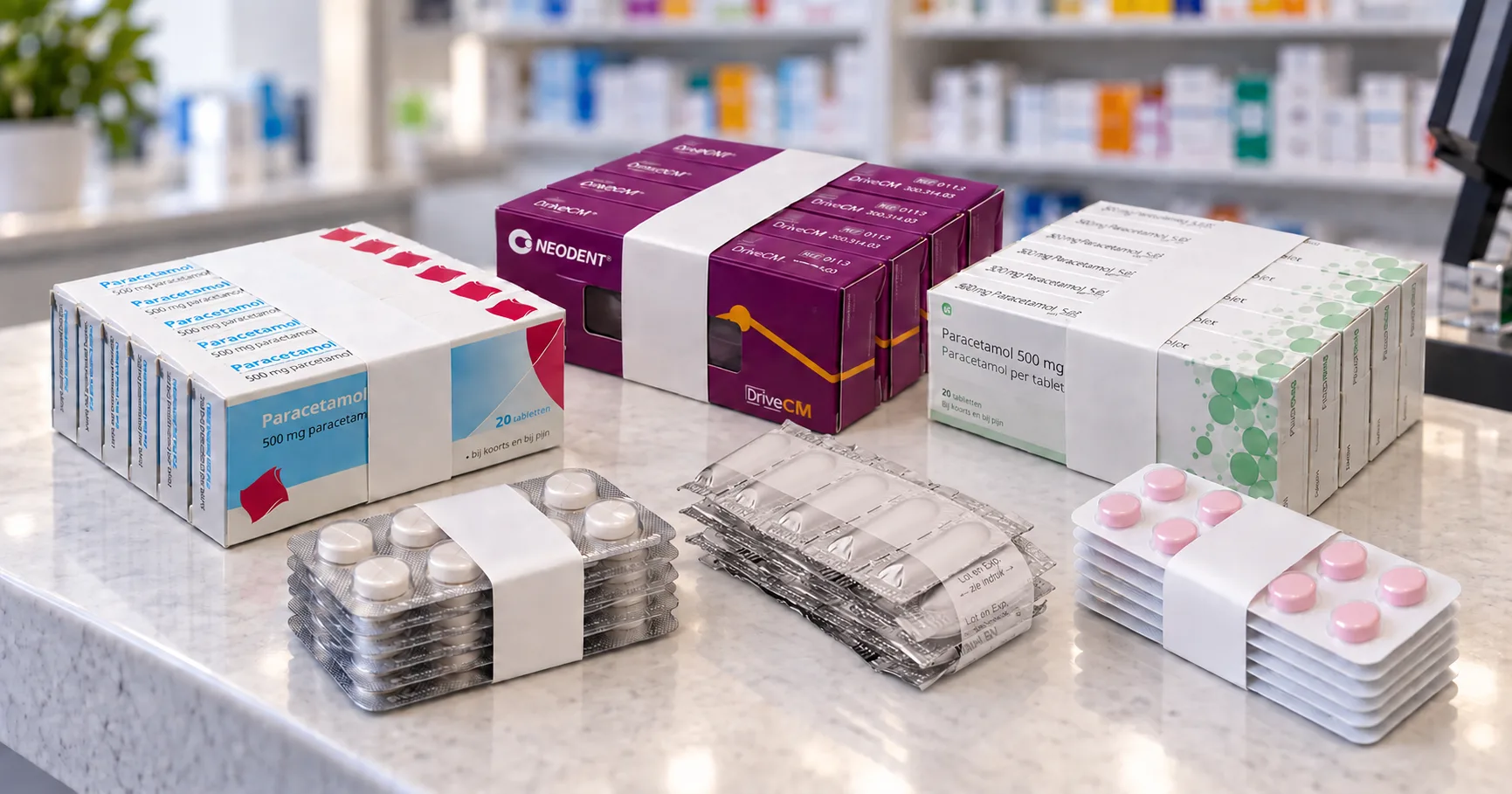
The common misunderstanding is that a band replaces the product’s own carton. It does not. The medicine cartons, the blisters, the strip packs all stay exactly as they are. What the band replaces is the shrink film wrapped around a group of them, or the outer carton they would otherwise be shipped in.
In practice, most SRP in this region is shrink wrapped. That means a heat tunnel, a film that covers the whole pack, and a separate label for anything that has to be read.
Where pharmacy differs from the supermarket
In food and general retail SRP, the band’s job is mostly holding. Six spice cartons, a toothpaste multipack, a tray of yoghurt. Tamper evidence rarely comes up, because nobody is worried about a pack of spices being opened on the shelf.
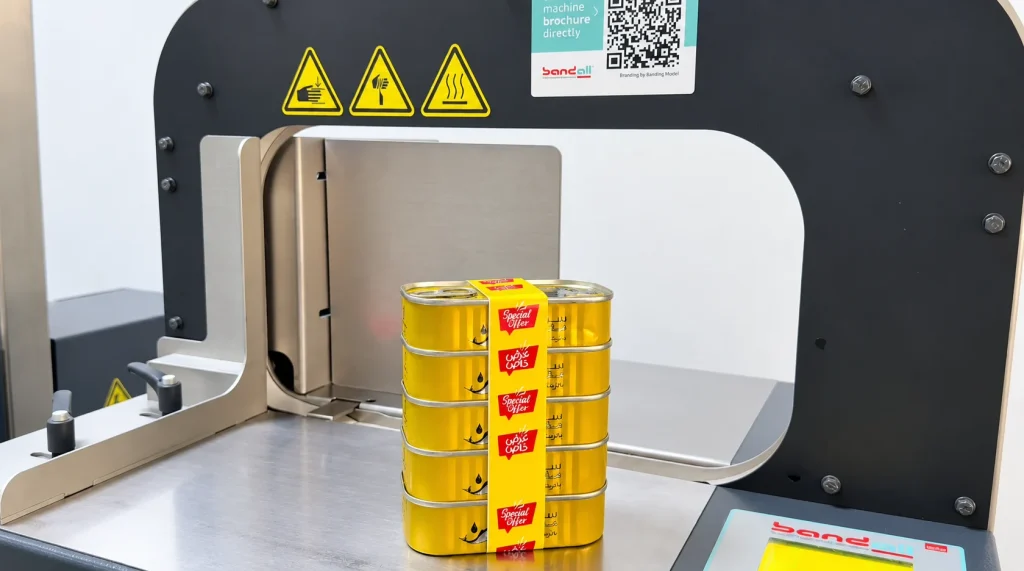
Pharmacy is the opposite. The pack has to show whether it has been interfered with, and a sealed paper band does that structurally: it cannot be slipped off and put back without breaking. There is no separate seal to buy and apply.
The second difference is what has to be printed. A food multipack needs a barcode and maybe a promotional message. A medicine pack needs batch number, expiry date, barcode, and increasingly a QR code or data matrix for serialisation. All of that prints onto the band as it is applied, in the same pass that holds the pack together.
What this looks like on a real line
We supplied a pharmaceutical customer shipping to Iraq, banding cartons of ten tablet packs.
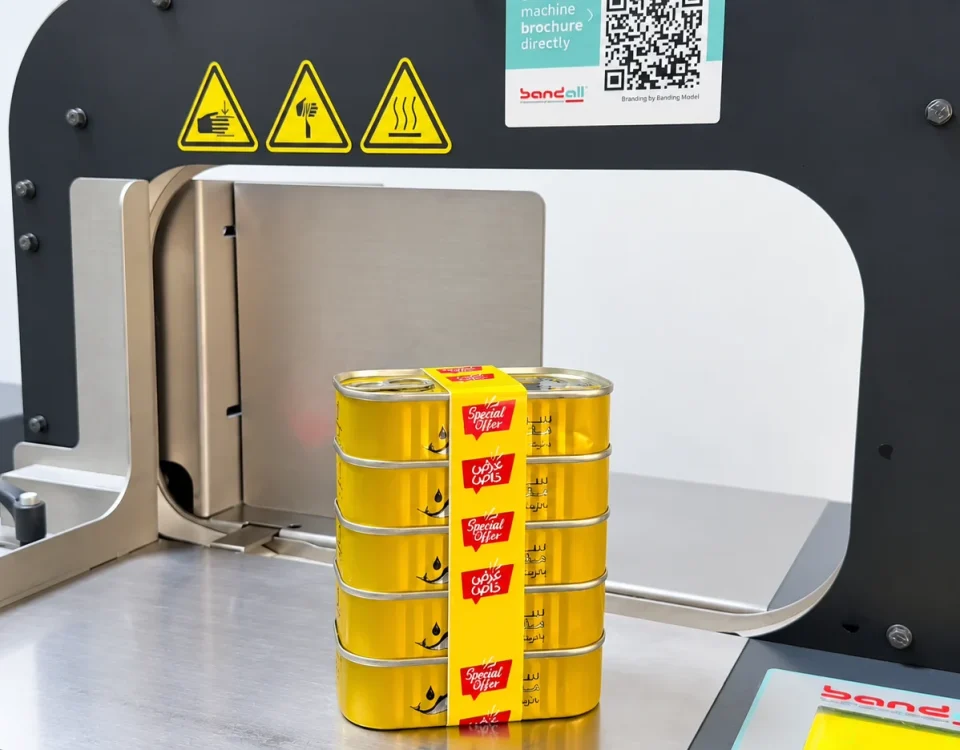
The format is ordinary: small cardboard medicine cartons, stacked, held with one printed band. The same machine handles blister stacks, strip packs, half-cut cartons and trays — the format changes, the roll and the tension change, the machine does not.
That matters more in pharmacy than elsewhere, because a manufacturer typically runs dozens of SKUs in different carton sizes. A line built around tooling needs a new die for each one. A banding line does not.
The operator count
Here is the comparison that tends to decide it, and it is not about material.
A shrink line usually needs two operators: one feeding the infeed, one at the outfeed. Banding needs one, in a single step. On a line running a full shift, that difference compounds in a way the film cost never does.
The material difference is real too — a band uses up to 80% less material than shrink film because it covers a strip rather than the whole pack, and a banding machine uses up to 90% less energy because there is no heat tunnel. But those are the numbers people expect. The operator count is the one that changes the business case.
Opening it
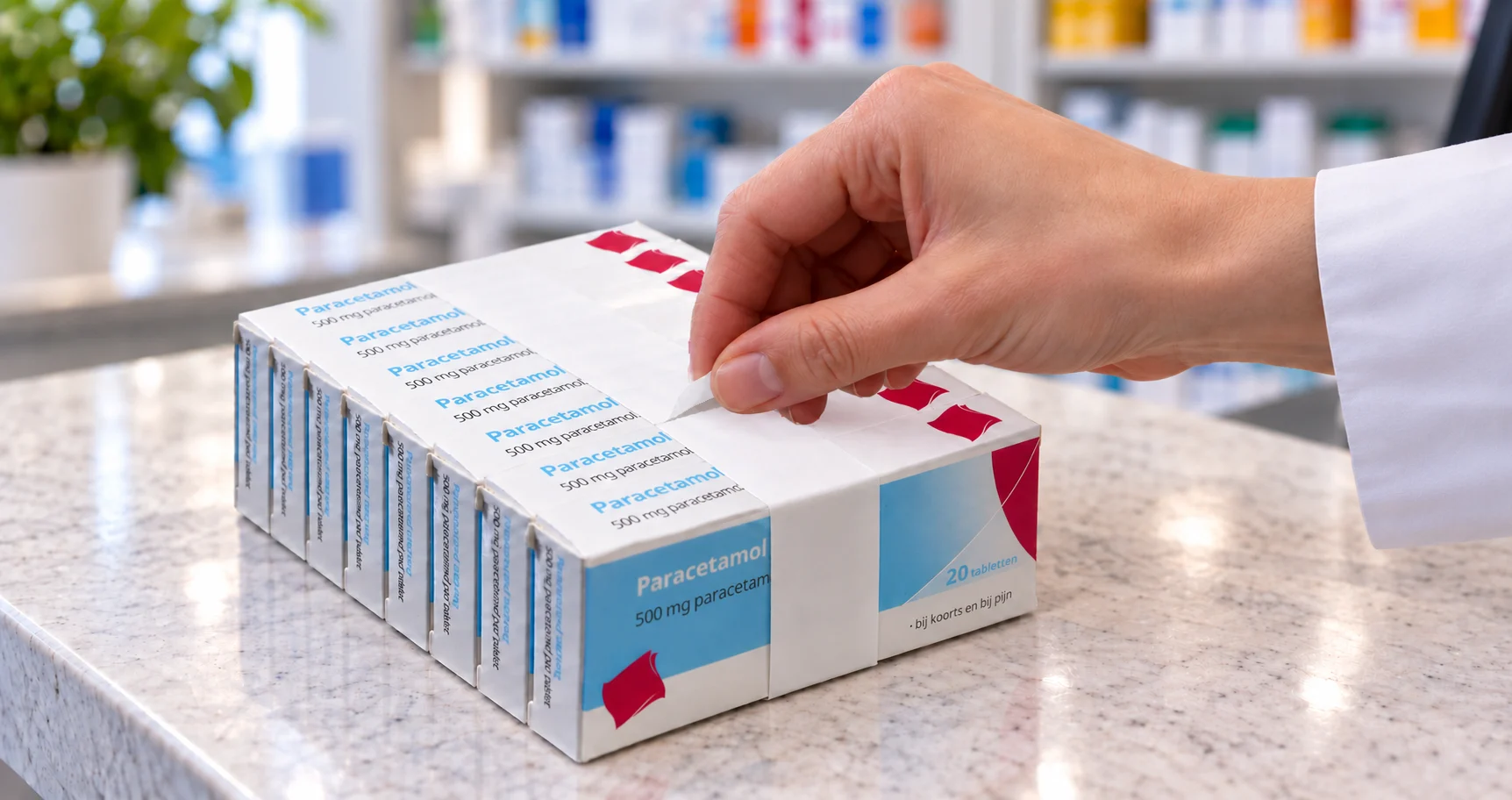
Shrink film and tape both need something sharp to get into. In a pharmacy, that means a staff member cutting into a pack of medicine with a knife, which is exactly where cartons get damaged.
A band can be supplied with a small tear strip left sticking out. Pull it, the band opens, the cartons are intact and ready for the shelf. No tool, no cut, nothing sharp near the product.
Scaling
SRP volumes vary enormously between a local manufacturer and an export line, so the machine scales rather than being replaced.
A stand alone machine is operator fed and suits batch work and seasonal SKUs. A fully automatic machine sits inline and runs continuously. A multi-head configuration takes it up to five times the throughput of a single head, for export lines where the volume justifies it.
The consumable, the print setup and the operator training stay the same across all three.
Where banding is not the answer
If the requirement is a full moisture barrier across the whole pack, that is shrink film, not a band — a band covers a strip by design.
Closing a shipping carton for export stays with tape. Heavy or long loads stay with strapping.
And some arrangements simply do not band: the items have to form a block the band can close around and hold. A stack of cartons does. A loose group that does not sit square will not.
Test it on your own cartons
Send us a sample of the pack you want banded, or bring it to our showroom in Dubai Investments Park. We band it, film it and send the banded samples back within two working days, with the tamper evidence and the print exactly as it would run on your line.
Send us your pack for a free trial — contact us, see how shelf ready packaging works more broadly, or look at pharmacy banding and printing while banding.
Frequently asked questions
What is shelf ready packaging in pharmacy?
A pack that arrives at the pharmacy and goes straight onto the shelf without being unpacked into a display. For medicines it also has to show whether it has been opened, which is where it differs from food SRP.
Does a band replace the medicine carton?
No. The cartons, blisters and strip packs stay exactly as they are. The band replaces the shrink film wrapped around a group of them, or the outer carton they would otherwise ship in.
How does a band provide tamper evidence?
The band is sealed onto itself, so it cannot be slipped off and replaced without breaking. The evidence is structural, with no separate seal to buy and apply.
What can be printed on the band?
Batch number, expiry date, barcode, and QR or data matrix codes for serialisation — all printed as the band is applied, in the same pass that holds the pack together.
How many operators does a banding line need?
One. A shrink line usually needs two, one at the infeed and one at the outfeed. On a full shift that difference matters more than the material cost.
How do pharmacy staff open a banded pack?
The band can carry a small tear strip. Pulling it opens the pack with no knife or scissors, so nothing sharp goes near the cartons.
Can one machine handle different carton sizes?
Yes, within its band width range. The format changes, the roll and the tension change, the machine does not — there is no die to cut for each SKU.