
Banding Blankets and Linen for Airline Laundries

Pharmaceutical Shelf Ready Packaging
2026-10-05
Banding Machine Price UAE: What Drives the Cost
2026-10-07Airline laundry banding solves a problem that has very little to do with holding things together. The folded blanket is already stable. What the laundry needs is for that bundle to stay clean, stay identifiable, and arrive at the aircraft or the hotel floor looking like it came from somewhere that cares.

That is a packaging question, and most of the usual answers damage the textile on the way.
What the laundry actually has to get right
Folded fabric is one of the easiest things to mark. A plastic strap concentrates its whole holding force along a narrow line, and on a compressed stack of towelling or a blanket that line becomes a crease that survives the next wash. Shrink film gets there a different way and no better: it puts heat and a full plastic wrap over a textile that has just been pressed.
A band spreads the same holding force across a much wider surface, and the tension is set from the machine menu rather than by how hard the operator pulls. Low enough for a loosely folded blanket. Higher for a compressed stack of sheets that has to be moved and stacked again. One machine, one setting per product.
The feed matters as much as the tension. The band loop is formed in the arch above the product before the stack arrives, so nothing is threaded around the linen and the stack is never lifted or turned. The vacuum feed guides the band around the bundle instead of dragging it across the corners, which is where folded edges normally get scuffed.
Why nearly all of it is paper
Across the laundry work we quote, about nine out of ten choices come out as paper rather than film. The reason is not technical. It is sustainability.
A paper band goes into ordinary paper recycling — not a specialist plastic stream, and not into a hotel’s or an airline’s plastic figures. For operators who have a plastic reduction target written down somewhere, swapping film for paper on a linen bundle is one of the least disruptive changes available: same machine, same speed, different roll.
Film still has its place where moisture does. A damp store, a load that waits outside, condensation in a Gulf August. Paper weakens against all three and film does not. But in an airline or hotel laundry the bundle usually goes straight from the folding line into a clean, dry store, and paper wins on the sustainability argument alone.
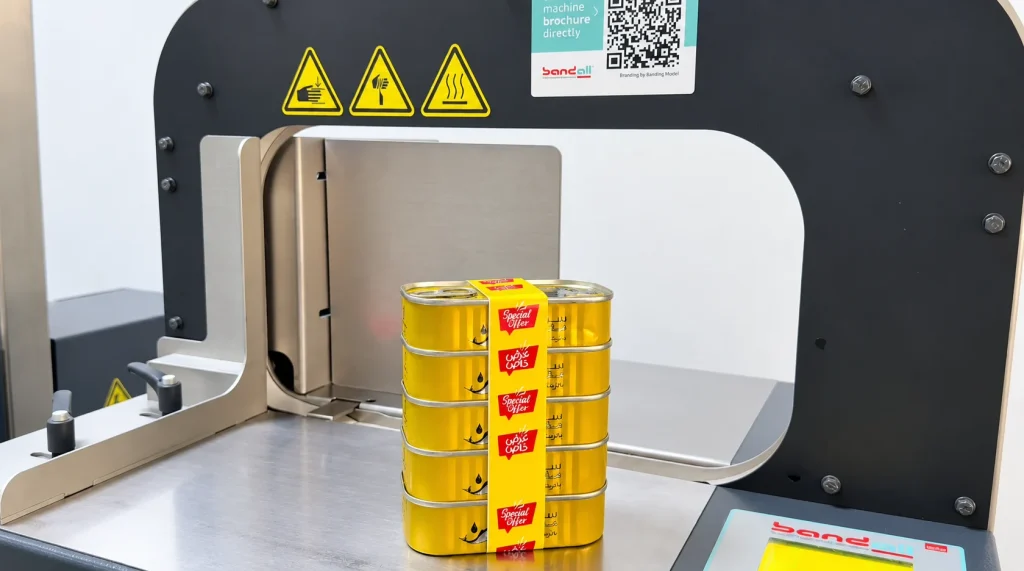
The band is where the branding goes
This is the part that gets underestimated.
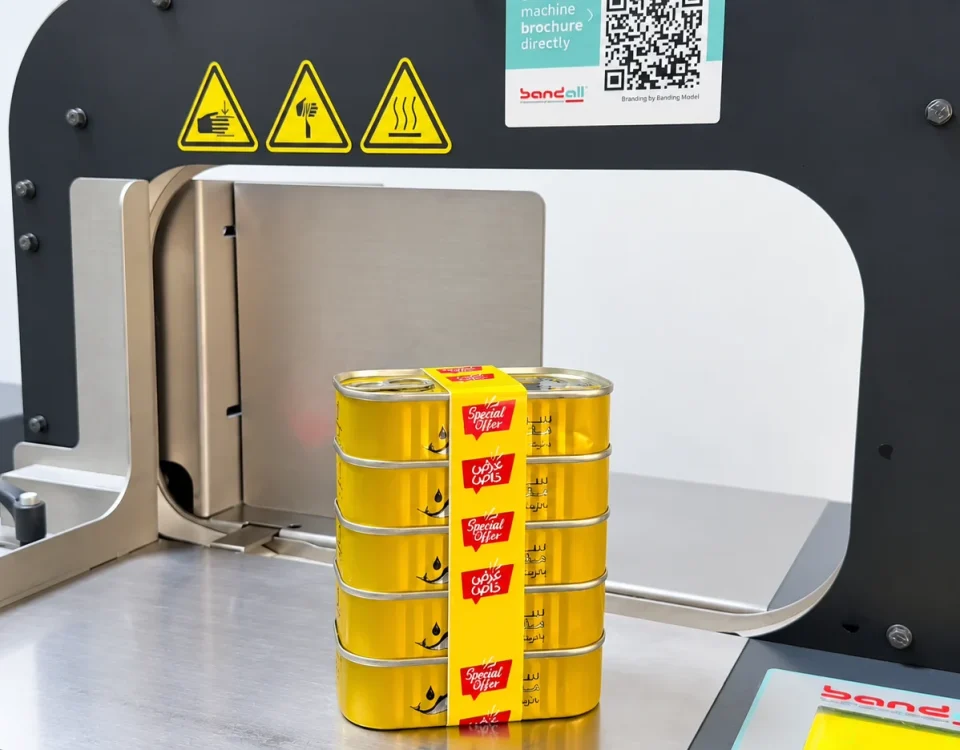
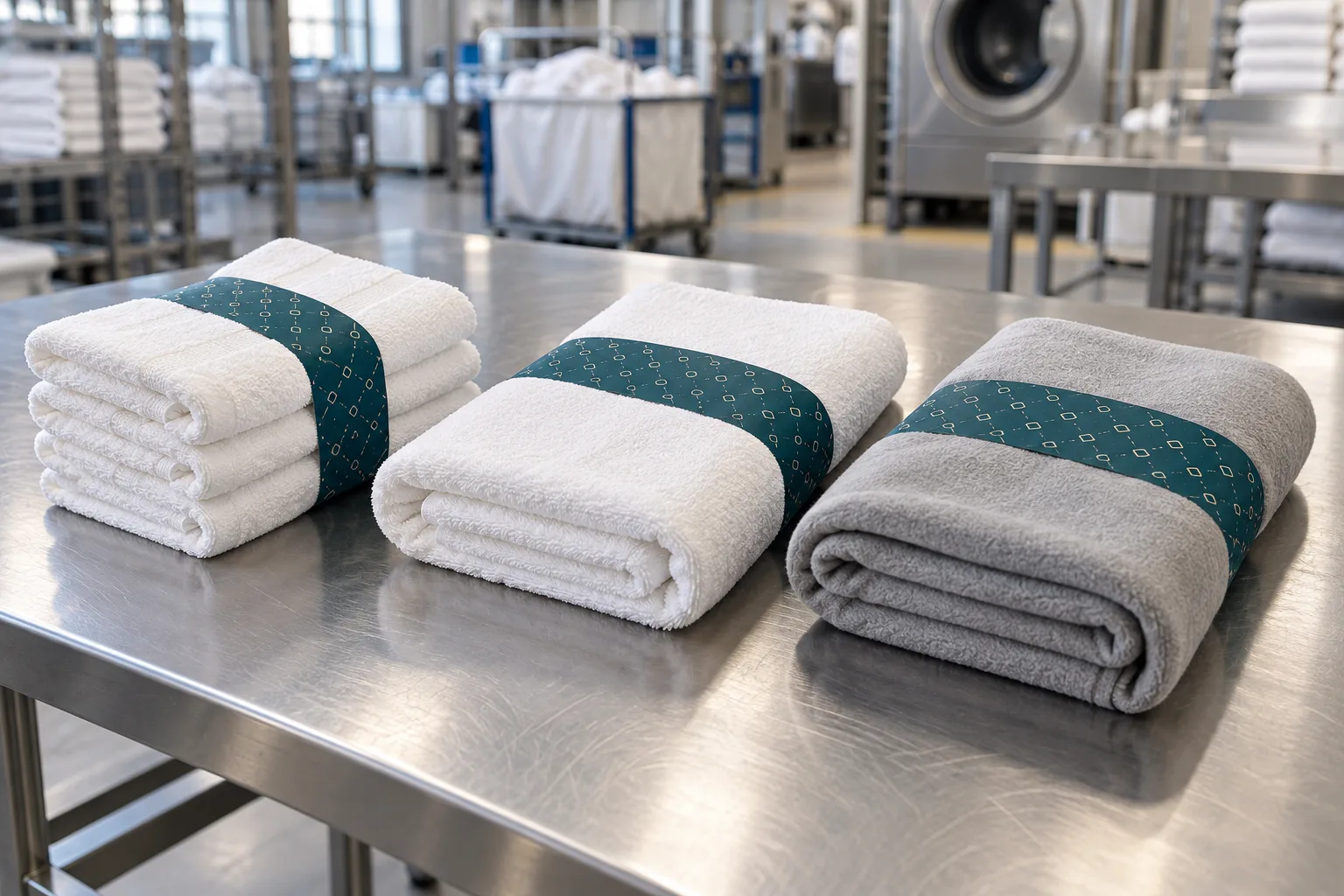
What usually prints on a laundry band is the hotel’s or the airline’s own branding. Not a code, not a warehouse number — the identity. The bundle is one of the few pieces of back-of-house packaging that a guest or a passenger actually sees, when a blanket is handed over still banded or a stack of towels is set down in a room.
Two ways to get it there. A pre-printed roll carries fixed artwork, which suits a single airline or a single hotel group running the same design all year — it does have a minimum order of 100 rolls and around three weeks’ lead time, so it needs planning. A plain roll with an integrated printer takes variable data at the moment of banding instead, for anything that changes between batches.
Most operations run both: fixed branding printed in advance, anything variable added inline.
Which machine fits a laundry
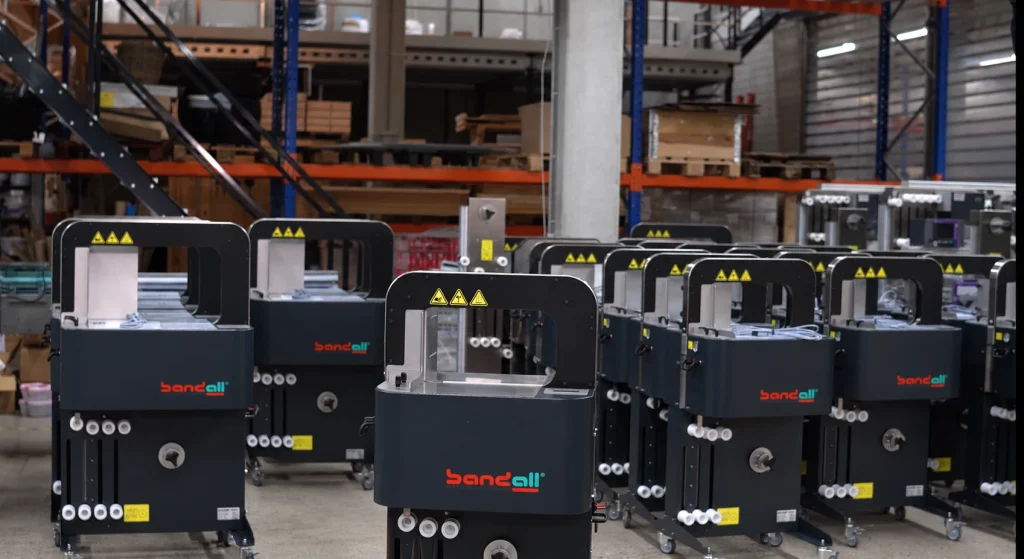
A stand alone machine is operator fed and sits beside the folding table. It needs ordinary single phase mains, an air compressor, a roll and the product — no three phase supply, no installation project. It runs on four wheels, so it moves when the laundry rearranges its floor.
For a line, the TRB guides product on driven conveyor belts and is built for exactly this kind of stack. The V-TRB version reaches 40 bands per minute, which is double the standard head. A single head is quoted at up to 1,200 packs per hour on a stand alone machine, but on an operator-fed station the operator is the limit long before the machine is.
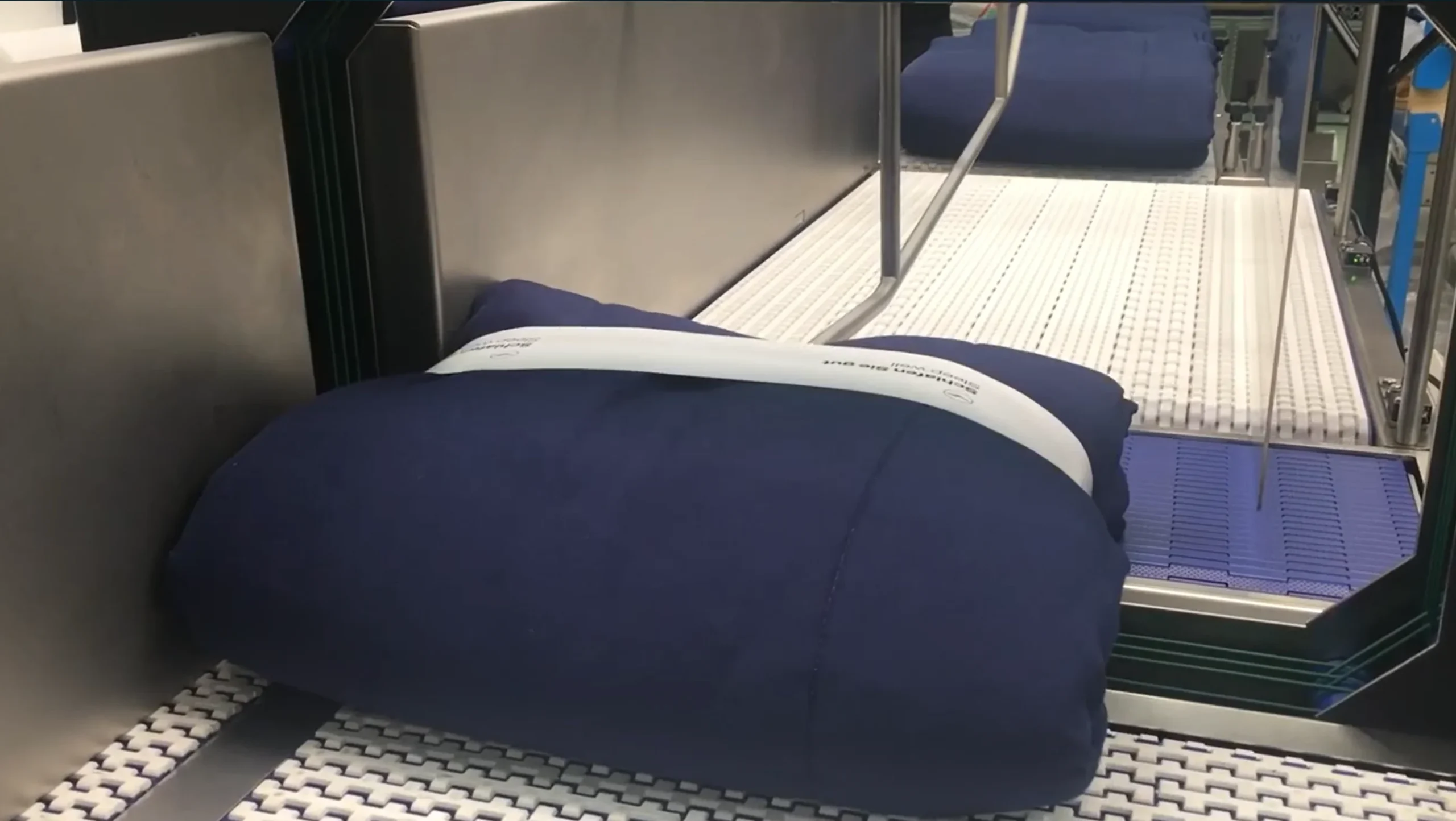
The photograph below is a line doing precisely this: folded airline blankets moving out of the machine on the belts, each already carrying the airline’s own goodnight message printed across the band. Nobody placed that print. It arrived with the band.
What it costs to run
There is no heat tunnel anywhere in this. The line starts cold, bands the first bundle of the shift, and draws nothing while it idles between loads — a banding machine uses up to 90% less energy than a shrink wrapping machine for that reason alone.
Material is easy to work out before you commit to anything. Measure the distance around the bundle, add two centimetres for the overlap, and divide the roll length by that. You get bundles per roll, and from there cost per bundle.

Changeover is where laundries usually expect trouble and do not find it. With a plain roll, or a roll carrying only your own branding, a different linen size needs no change at all — the band width range covers it. A roll only gets swapped when the printed data is specific to one product, and that takes about two minutes. There is no die and no tooling to cut for a new bundle size.
Where this is going in the region
We do not have an installed airline laundry in the region yet. We are in discussion with a regional carrier on exactly this application, and we have the demo footage from it, which is what you see in this article.
That is worth saying plainly, because it is also the reason the trial is free and fast: we want the reference as much as you want the proof.
Where banding is not the answer
Bulk transport loads stay with strapping. Securing a full cage or a trolley for transport is high-tension work on a structural load. A paper or film band is not built for it.
Closed shipping cartons stay with tape. A band holds a neat stack of bundles together. The closure of a carton that has to survive a pallet stack is a different job.
A full moisture barrier stays with shrink. A band covers a strip of the bundle by design. If the linen is going to sit outside or travel by sea, that is a wrap, not a band.
And the arrangement has to cooperate. A folded stack that sits square makes a block the band can close around and hold. A loose armful of towelling does not, however the tension is set.
Arrange a trial with your own linen
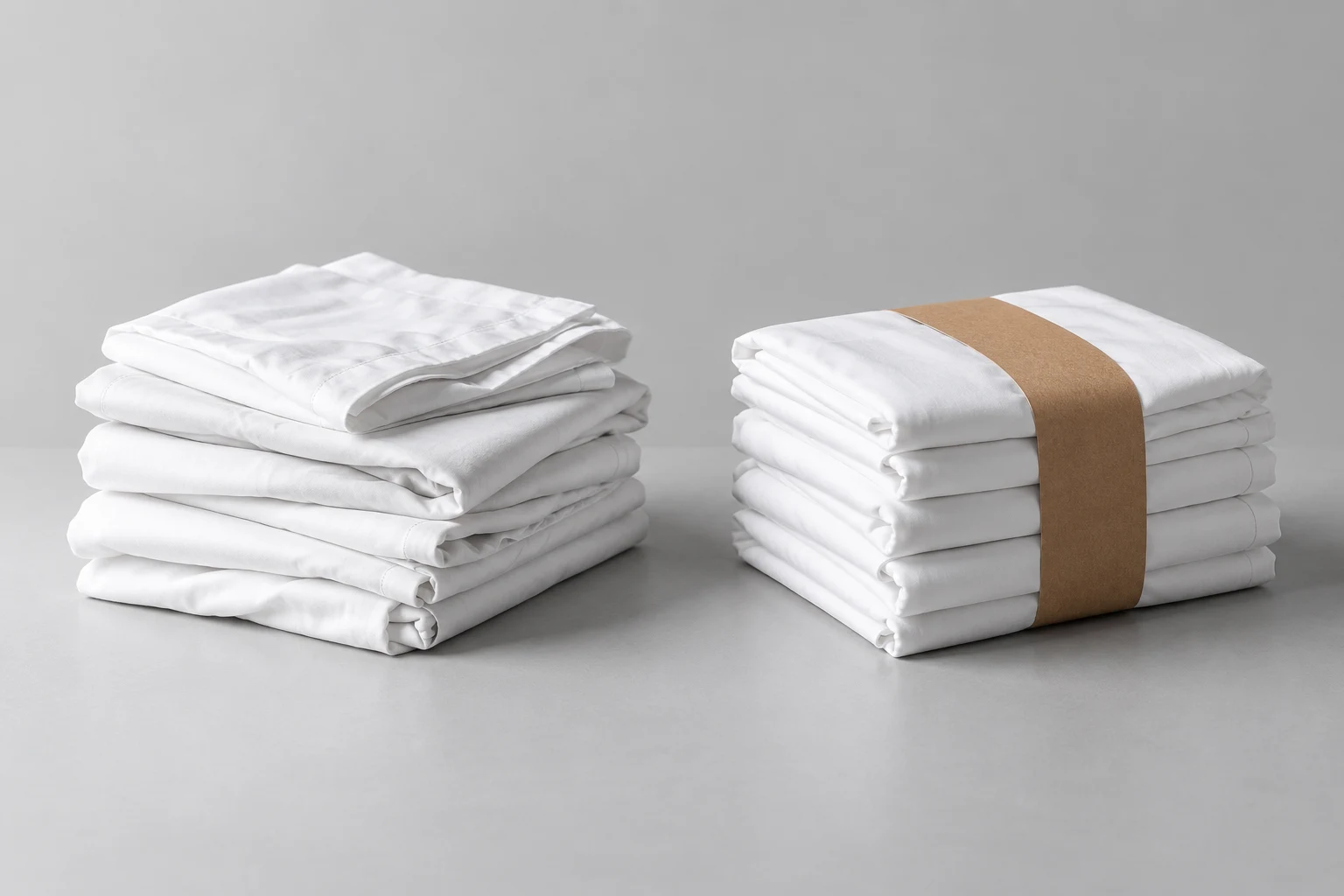
Send us a bundle of your own linen, or bring it to the showroom in Dubai Investments Park. We band it on the machine that suits it and send back photographs, video and the banded bundles themselves within two working days — with your branding on the band if you give us the artwork.
After that the specification is straightforward. Bundle size sets the band width. Whether there is an operator at the folding table decides stand alone or inline. Whether the branding is fixed or changes decides pre-printed or inline printing.
Arrange a trial with your own linen — contact us, or look at laundry banding, banding for textiles and the paper band range.
Frequently asked questions
What is airline laundry banding?
Holding a folded bundle of blankets, sheets or towels together with a narrow paper or film band that is tensioned and sealed onto itself. The band carries the airline’s or hotel’s branding and takes the place of a plastic strap or a shrink wrap.
Does a band mark folded linen?
Not the way a strap does. A strap concentrates its force along a narrow line, which is what creases compressed fabric. A band spreads the same force across a much wider surface, and the tension is set from the machine menu rather than by hand.
Paper or film for blankets and linen?
Paper, in about nine out of ten cases, and the reason is sustainability — it goes into ordinary paper recycling. Film is the choice where the bundle meets moisture: a damp store, a load that waits outside, heavy condensation.
What gets printed on a laundry band?
Usually the hotel’s or the airline’s own branding. Fixed artwork comes on a pre-printed roll; anything that changes between batches is printed inline on a plain roll at the moment of banding.
How fast can a laundry line be banded?
A single head is quoted at up to 1,200 packs per hour, and on an operator-fed stand alone machine the operator is the limit rather than the machine. For a line, the V-TRB reaches 40 bands per minute.
What does a stand alone banding machine need installed?
Ordinary single phase mains, an air compressor, a roll of band and the product. No three phase supply and no installation project, and it sits on four wheels so it moves with the laundry.
Does changing linen size mean changing tooling?
No. With a plain roll or a roll carrying only your branding, a different bundle size needs no change within the band width range. A roll is only swapped when the printed data is specific to one product, which takes about two minutes.