
Tape vs Banding: When Each One Wins

What Is Banding?
2026-09-07
How to Choose a Bundling Machine
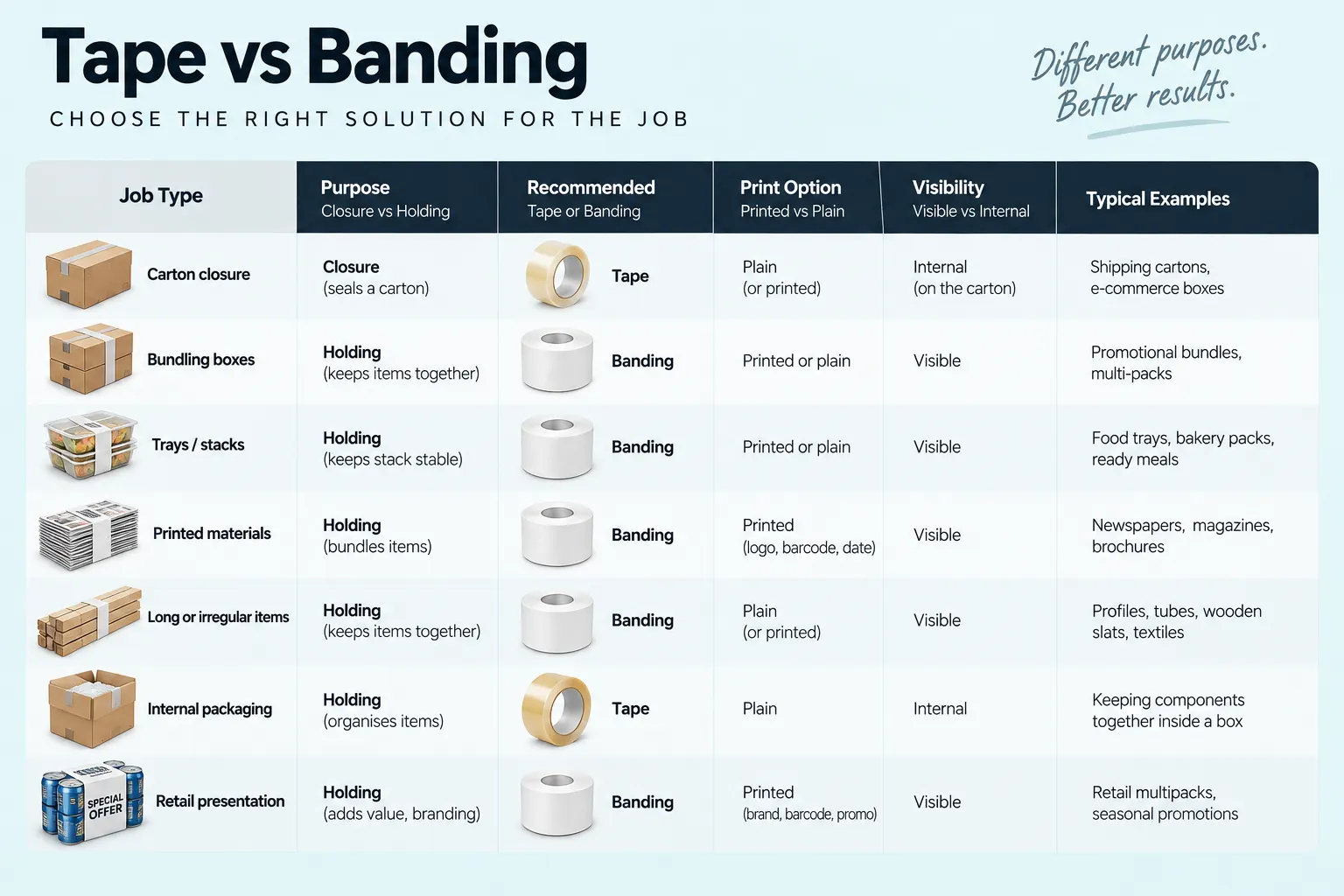
2026-09-14Tape vs banding is a comparison that gets muddled because the two are usually doing different jobs. Tape seals a carton shut. A band holds separate things together. Most of the time nobody has to choose.
The overlap is bundling, and that is where the question actually gets asked. Two boxes taped together for a promotion. A stack of trays wrapped in tape to keep it upright through despatch. In this region we see tape used for bundling far more than most people expect, which is exactly why it is worth comparing properly.
What tape does to the product
Adhesive has to grip something, and that something is your product.
On a printed carton, peeling the tape off lifts the ink. On a coated or varnished surface it lifts the coating. On a matt laminate it leaves a shine where the adhesive sat. None of this matters if the outer box gets binned. It matters a great deal if the pack the tape is holding is the pack the customer sees.
Then there are the surfaces tape simply does not like. Anything dusty. Anything cold. Anything with condensation on it, which in a Gulf chilled store is most things. Anything soft enough to move under the tape as it is applied. Any pouch. The adhesive either does not grip or grips unevenly and lets go three days later in a warehouse.
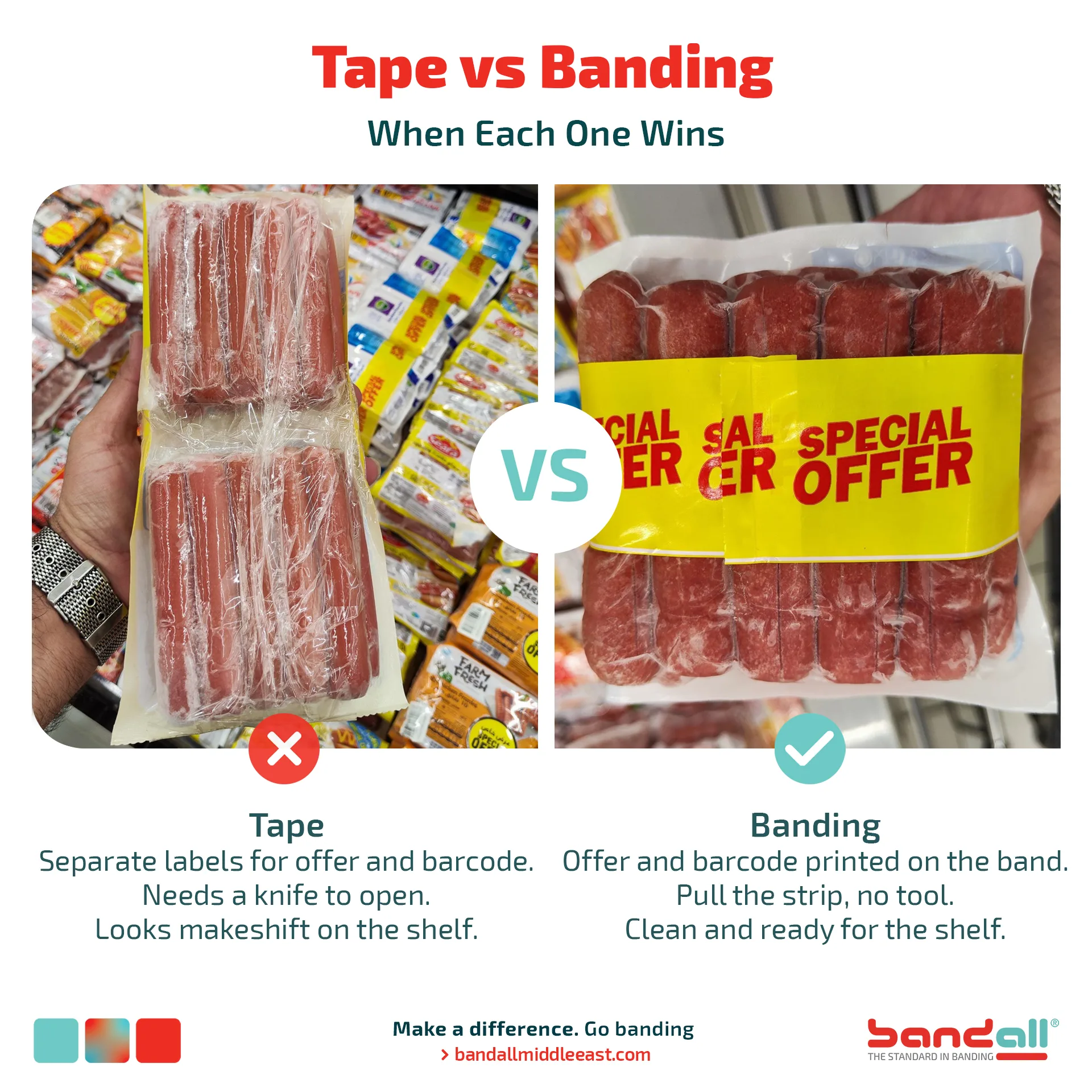
And removal is the customer’s problem. Tape has to be cut or torn, usually with a knife or a pair of scissors.
What a band does that tape cannot
A band does not stick to anything except itself. The overlap is sealed band-to-band, so the product underneath is never touched by adhesive and comes out of the bundle exactly as it went in.
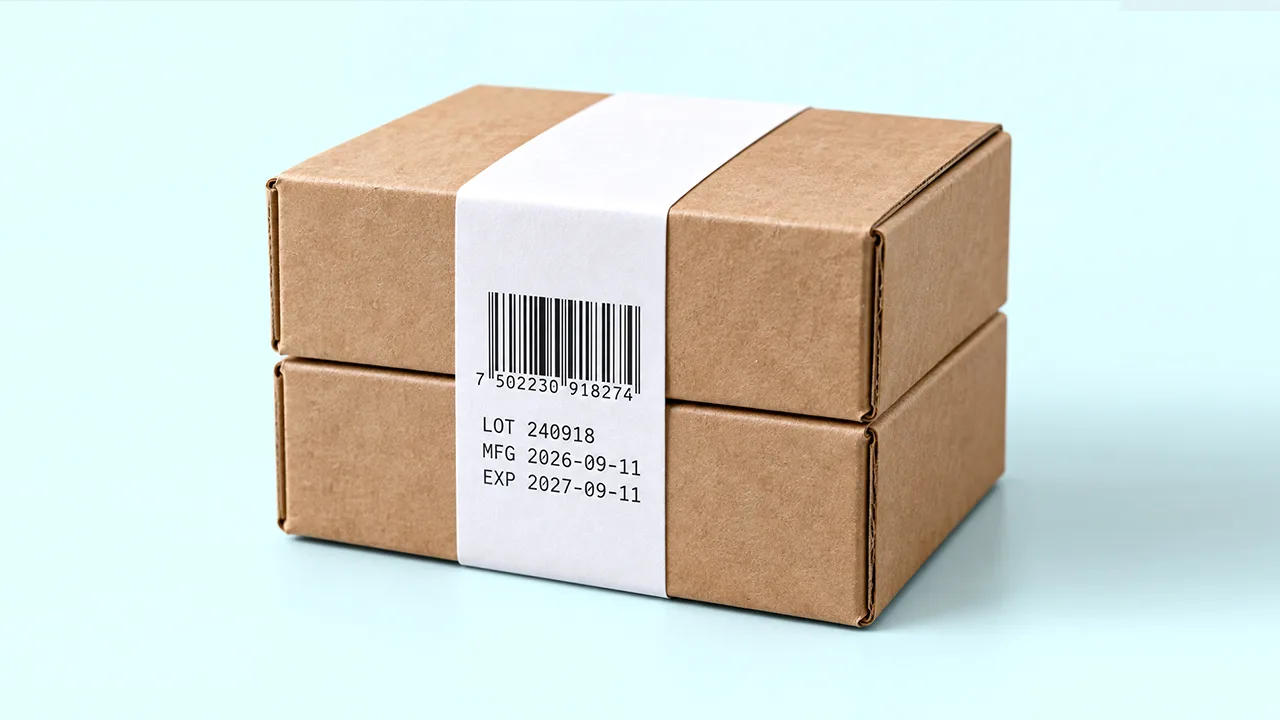
It is also a printed surface, which tape is not in any practical sense. A taped promotional pack usually needs two more things applied: a label for the offer and a label for the barcode. On a band, both are printed on the strip that is already holding the pack — one consumable and one application step instead of three. Batch numbers, weights and use-by dates go on the same way, either pre-printed or added inline as the band is applied.
Tension is set on the machine rather than in the operator’s hands. Every bundle gets the same force, which is not true of hand-taping and never has been.
Opening is easier too, which is the opposite of what people expect. The band can be left with a small tear strip sticking out: the customer pulls it and the pack is open. No knife, no scissors, nothing sharp near the product.
And there is a cost point people miss. Changing product does not mean changing anything. If the roll is unprinted, or printed with only your own branding, a new pack size needs no action at all — the machine and the operator carry on. Only product-specific printed information calls for a roll swap, and that takes about two minutes. There is no die anywhere in the process.
Where tape wins, plainly
This section exists because a comparison that only goes one way is not a comparison.
Sealing a shipping carton belongs to tape. Closing the flaps of a box that has to survive a pallet stack, a forklift and a truck is what tape is for. A band goes around the outside of a carton; it does not close the top of one. If your question is how to shut a box, the answer is tape and it is not close.
Heavy cartons belong to tape. The bigger and heavier the box, the more the closure has to resist forces a band was never designed for. Do not specify banding for it.
Sealing a seam against moisture belongs to tape. A band crosses a pack; it does not seal a join.
Where banding takes over is the moment the job stops being closure and starts being holding: several items together, a multipack, a promotional bundle, a stack going to a shelf.
The overlap: bundling
This is the honest battleground, and it is where most tape in this market is actually being used.
Take a two-for-one on a boxed product. Taped, it works — until someone peels the tape and takes the print with it, or until the pack sits in a chilled aisle and the adhesive gives up. Banded, the two boxes are held with a printed strip that carries the offer, comes off clean, and cost less to apply than the label the tape version still needs.
One caveat, because it decides more cases than anything else: the products have to form a block the band can close around. Four tuna cans stacked on top of each other band cleanly. Four tall cans of sweetcorn standing side by side do not — the band goes round and finds nothing to hold. Tape has the same limitation, incidentally. It is just less obvious until the bundle arrives in pieces.
If you are not sure which side of that line your product sits on, the answer takes a demo rather than a discussion.
How to decide in four questions
Are you closing a box, or holding things together? Closing is tape. Holding is a band.
Will a customer see this pack? If yes, the band wins on appearance and on clean removal.
Does anything need to be printed on it? Then it is a band, or it is tape plus a label — which is two consumables and two applications.
Is the surface cold, damp, dusty or soft? Adhesive will let you down. A band will not.
See it on your own product
The fastest way through all of this is a sample. Send us the pack you are currently taping, or bring it to the showroom in Dubai Investments Park. We band it, photograph it, film it, and send the banded samples back within two working days.
If the tape is staying for your shipping cartons, that is the right decision and we will say so. The question is only whether it is also doing a bundling job it was never suited for.
See it on your product — contact us with your details, read what banding is if you are new to it, or look at product bundling and the strapping comparison.
Frequently asked questions:
Is banding better than tape?
For bundling, generally yes: no adhesive on the product, a printed surface, consistent tension and clean removal. For sealing a shipping carton, no — that is tape’s job and banding does not replace it.
Can a banding machine seal a carton?
No. A band goes around a pack; it does not close the flaps of a box. If you need a carton sealed, use tape. If you need several cartons held together, use a band.
Does tape damage packaging?
It can. On printed cartons, peeling tape lifts ink. On coated or varnished surfaces it lifts the coating or leaves a mark. On cold, damp, dusty or soft surfaces the adhesive often does not grip properly in the first place.
Can you print on a band the way you cannot on tape?
Yes. Bands can be supplied pre-printed with your artwork, or left plain and printed inline during banding with variable data such as barcodes, weights, batch numbers and dates. A taped bundle needs a separate label for the same information.
What can be bundled with a band instead of tape?
Anything that forms a stable block. Four tuna cans stacked band cleanly; four tall cans side by side do not. Crisp packets, cheese, chocolate, biscuits, folded blankets and chilled multipacks all band on the same machine.
Is banding more expensive than tape?
Per metre, tape is cheaper. Per finished pack it is often not, once you add the label the taped bundle still needs, the rework when adhesive fails on a cold surface, and the damage caused on removal. We would rather calculate it for your line than argue it — send your production figures and your samples.